
Your Fingers Are Built for Gripping.
Not for This.
You've been here.
You're on a boulder problem you've been projecting for weeks. You lock into a small, sharp crimper — the kind that doesn't care about your feelings — and then: a sharp twinge at the base of your ring finger. Not pain exactly. More like a warning.
It doesn't go away.
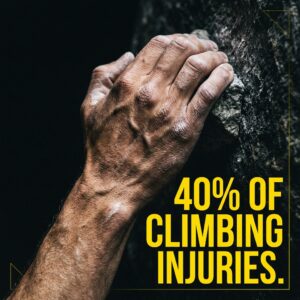
40% of all climbing injuries are finger injuries. And this isn't bad luck or weak tissue. It's just biology having a conversation with you — one you've been ignoring.
Your Fingers Have No Muscles in Them
This is the part worth understanding before anything else.
Your fingers contain zero muscle tissue. None. What they have are tendons — strong cables of connective tissue running from the muscles in your forearm all the way down to the bones of your fingers.
Think of it as a winch system: your forearm contracts, pulls a tendon, the tendon pulls your finger bone, your finger curls. No muscle inside the finger itself. Just a rope, some channels, and a bone.
Open your palm right now. Flex and extend your fingers. Watch the tendons move under the skin. That's your flexor system doing its job. That's what you're asking to carry your full body weight on a 12mm edge.
Why Climbing Specifically Breaks Them Down
Here's where it gets uncomfortable.
When you hang from a small hold in a full crimp — thumb locked over index, maximum grip — the force on your tendon doesn't equal your body weight. It multiplies. Depending on the hold angle and how hard you pull, you're looking at up to 6 times the load you're hanging from.
That's not a metaphor. That's a load cell reading.
Now add a dynamic movement — a controlled fall, split-second miss, a lunge for a hold — and your tendon slams against the pulley at the end of that sheath like a cable whipping through a winch under load. Do that hundreds of times per session. That's what climbing is. That's why the injuries are real.
The Four Things That Can Actually Go Wrong
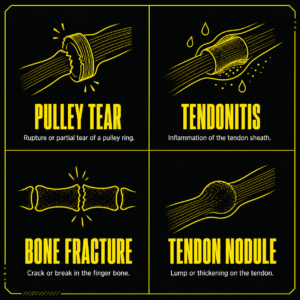
1. Pulley Injury
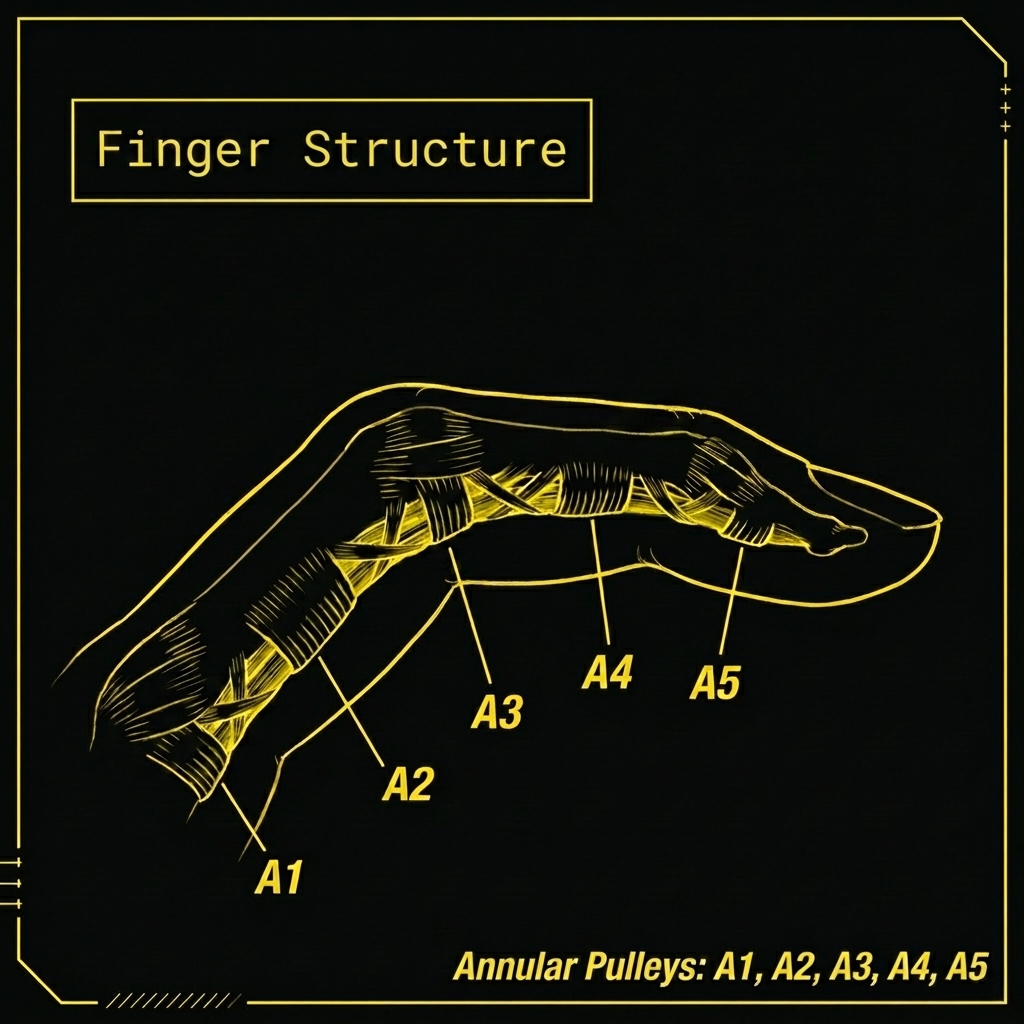
The A2 pulley is the one that takes the hit.
Located at the base of your finger — first phalanx, closest to your palm — the A2 is the workhorse of your finger. It holds your tendon against your bone under full crimp load. And it's the one that thins, inflames, or tears.
What it feels like: Sharp, pinpoint pain at the base of the finger. Tenderness when you press directly on it. Pain specifically when gripping in a closed-hand position.
In severe cases: a visible gap between the tendon and bone. Clinically called bowing. Less clinically called: not good.
The numbers:
- A2 pulley injuries account for over 80% of all climbing pulley injuries
- 60% of climbers graded 7a and above have experienced at least one pulley injury
2. Tenosynovitis
This is the sheath inflammation — the channel around the tendon getting angry.
What it feels like: Diffuse pain along the finger (not pinpointed at one spot). Visible swelling. A clicking or creaking sensation when you move the finger — like sand in a hinge. Morning stiffness that loosens up with movement but comes back.
3. Stress Fracture
Micro-fractures in the finger bones from repeated loading without enough recovery.
What it feels like: Deep, dull, bone-level pain. Different from tendon pain — it's in the bone itself, not around it. A precise, pinpoint tender spot. Pain that gets worse under load and improves with rest.
This is the one that gets missed. Climbers often assume it's a pulley strain and keep training through it. Don't.
4. Tendon Nodule
Scar tissue building up on the tendon after repeated microtrauma.
What it feels like: A lump you can feel under the skin. Pain when you press on it. In advanced cases: loss of range of motion in that finger.
The Five Mistakes That Keep Injuring Climbers' Fingers
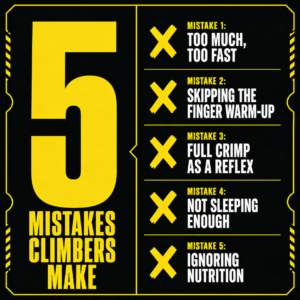
Mistake 1: Too Much, Too Fast
This is the most common one. You send your first 7a. You add a training day. You commit to a hard project. You train through the mild pain.
Here's the problem: muscles adapt in weeks. Connective tissue takes months. Tendons, pulleys, and sheaths remodel slowly. If you're increasing training volume faster than your tissue can adapt, you're running a tissue deficit. That deficit compounds.
The practical rule: Don't increase weekly training volume by more than 10%. It sounds conservative. It is. It's also the only thing that keeps you in the game long-term.
Mistake 2: Skipping the Finger Warm-Up
Your fingers need a specific warm-up — not just general body movement, but targeted activation of the finger flexor system before it takes load.
Cold connective tissue is stiff connective tissue. Stiff tissue doesn't absorb load well. A few rounds on a hangboard with minimal or no weight, some finger mobility drills, progressive open/close hand movements — this is what lubricates your sheaths before the real work starts.
10-15 minutes. Before you climb. Not negotiable.
Mistake 3: Full Crimp as a Reflex
The full crimp loads your A2 and A4 pulleys to maximum. Necessary for certain holds — deep pockets, sharp incuts, bad angles.
But if you can execute a hold with a half-crimp or an open-hand grip, you're significantly reducing the load on your pulleys. A lot of climbers full-crimp out of habit. Out of tension. Out of fear of letting go.
Full crimp when you need it. Not because it's your default.
Mistake 4: Not Sleeping Enough
Here's the one nobody talks about enough: the majority of connective tissue repair happens during sleep. Not in the gym. Not in the hours after training. While you're unconscious.
If you're consistently sleeping 5-6 hours, you're not recovering fully. If you're not recovering fully, you're running a tissue deficit. That deficit compounds — over weeks and months — until something gives.
For general health: 7-8 hours minimum. For tissue repair specifically: 8-9 hours is the smart target.
Mistake 5: Ignoring Nutrition
Your pulleys are made of collagen. Not muscle — collagen. A structural protein your body builds from amino acids, vitamin C, silicon, and other nutrients.
If your diet doesn't supply the building blocks for collagen synthesis, your tissue repair is slower and of lower quality. It's not complicated. It's just biochemistry.
This is something most climbers are leaving on the table.
The Good News
Finger injuries — caught early — heal well. A partially damaged A2 pulley can make a full recovery with the right combination of rest, targeted physiotherapy, and proper nutrition.
The injuries that don't heal are the ones where the climber kept ignoring the warning signs. The twinge becomes a strain. The strain becomes a tear. The tear becomes months off the wall.
Take the warning signs seriously. That's the whole game.
Join the HEXVEX Newsletter
We're building a collagen supplement specifically designed for climbers — with the doses the science actually supports.
We're sharing everything we learn along the way: the science, the research, the real-world testing results. No hype. No "trust me bro". Just the data.